
Tucker Projected and Actual Release
A projected date anticipates what may happen if the current sentence data and credit assumptions remain valid. An actual release date records what did happen. West Virginia’s supported official term is “minimum discharge date.” The Parole Board FAQ describes it as the date a person can expect release from WVDCR custody if not paroled, escaped, or deprived of good time. It is not a historical release event and should not be reported as one.
A pretrial detainee at Tygart Valley may have no set release date. Bond processing, a dismissal, a court order, a detainer, or the case outcome can control when the custody episode ends. A sentenced state prisoner has a correctional computation, but it can still change. The two populations belong in separate lookup paths.
Parole eligibility is another distinct date. It marks when the Board may consider release, not when release must occur. A Board grant may also precede physical departure while required processing continues.
Find Tucker Projected Release Dates
Choose the system based on the custody episode. Tucker adults held on local matters normally enter WVDCR’s regional-jail system at Tygart Valley. A person committed to state prison belongs in the prison search. The WVDCR offender-search hub keeps Daily Incarcerations, jail search, and prison search separate. Daily Incarcerations is a present-custody reference, not a date calculator or release archive.
- Identify the Tucker County case, the facility, and whether the person is pretrial, serving a local term, or committed to state prison.
- Search the WVDCR jail tool for the regional-jail episode. Use the prison tool only when a state-prison commitment is supported.
- Match an identifier where possible, open the record, and copy the exact status and date labels. Do not assume every result shows a forward-looking date.
- For a state sentence, compare any displayed date with the sentencing order and WVDCR computation. Ask DCR Records about a missing or disputed time sheet.
- For a regional-jail term, ask Tygart Valley for the actual release entry and ask the sentencing court for the order that controls the term.
The official offender-search landing page shows the three distinct search choices. Its WVDCR custody search options are captured below. The broader Tucker County released-inmate lookup shows how to reconcile those tools with the court and release record.
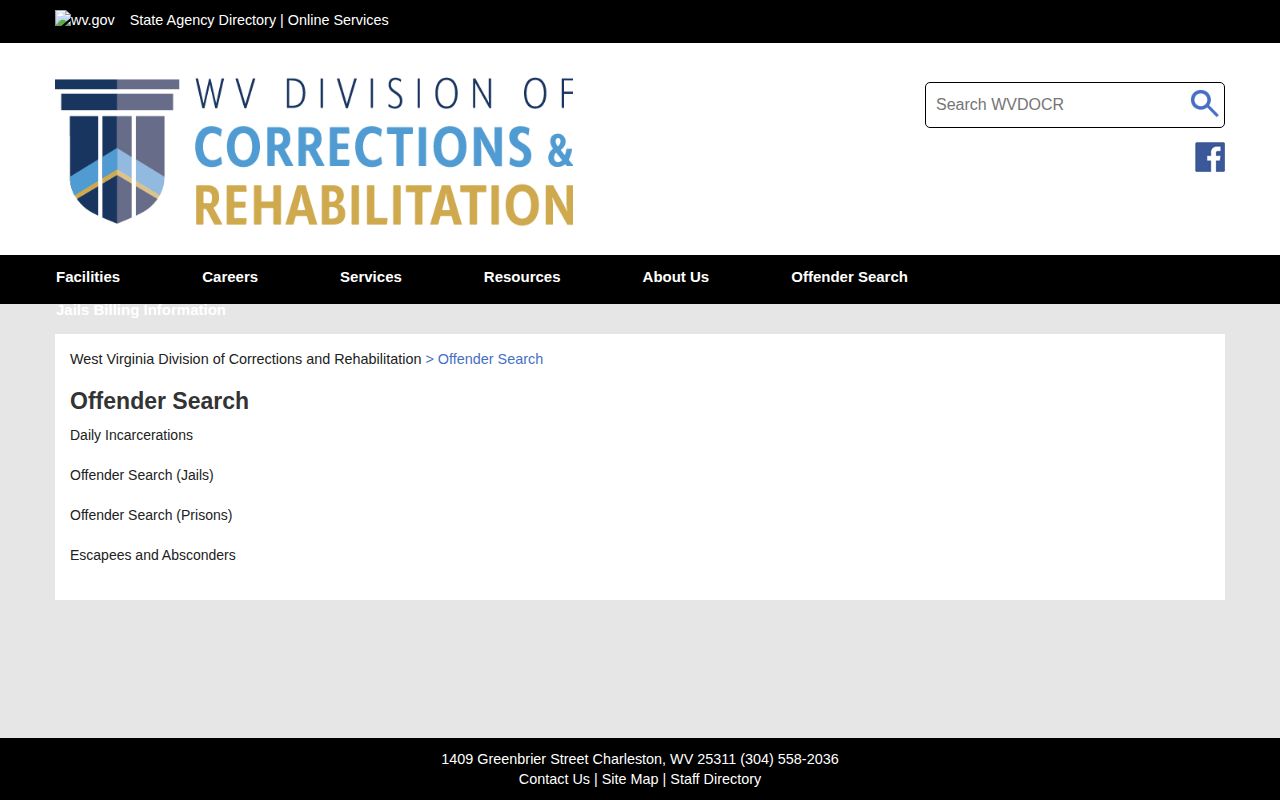
The split helps prevent a regional-jail absence from being mistaken for state-prison discharge. If no historical result appears, request the existing record rather than treating “not found” as a release date.
Note: Record the retrieval date because correctional status and forward-looking computations can change after a later court or agency action.
Tucker Release Date Terms
Several labels can appear in a Tucker County release-date inquiry. They do not describe the same event. Keeping them distinct prevents a forecast or hearing threshold from becoming an unsupported claim of release.
- Booking date
- The start of one recorded custody episode.
- Parole eligibility date
- The point when the Board may consider parole under the governing sentence and law.
- Minimum discharge date
- WVDCR’s expected end of custody under current sentence and good-time assumptions.
- Actual release date
- The recorded date the named custodian’s custody ended.
- Detainer
- Authority for another agency to take or continue custody after the first basis ends.
“Released from Tygart Valley” names the facility that a person left. “Transferred” means custody continued somewhere else. “Paroled” means conditional community release authorized by the Board, with supervision still active. “Discharged” should be used only when the responsible correctional, parole, or court record supports the final status.
Tucker Good-Time Release Computation
For covered felony sentences, West Virginia Code §15A-4-17 generally provides one day of good time for each day incarcerated. The framework includes exceptions and permits loss under statute and policy. WVDCR Policy Directive 151.06 addresses the computation, including jail credit and circumstances when time outside physical custody does not earn good time.
That rule should not be turned into a personal calculation from the sentence headline. The record must account for the exact sentence structure, qualifying time, credited jail days, any loss or restoration of credit, and later legal events. Consecutive sentences can make the computation differ from a simple reading of one term. An offense-specific mandatory minimum can also restrict the result.
West Virginia has no universal rule in the reviewed research that all prisoners must serve 85 percent. The general provision uses a one-for-one good-time framework for covered sentences, subject to its limits. Federal shorthand and rules from other states do not control a Tucker County state case.
WVDCR's time sheet, not a rough estimate, is the record to seek when a minimum discharge date is disputed. Compare that computation with the signed sentencing order and any later order that corrects credit or sentence structure. If the documents conflict, record the date of each version and ask WVDCR Records which order and credit entries control the active calculation. This keeps a Tucker County forecast tied to the official inputs instead of unsourced arithmetic.
Good-time note: The statute supplies a framework, not a guaranteed release day. Obtain WVDCR’s computation for the named sentence.
What Changes Tucker Release Dates
A minimum discharge date can move when inputs change. Some events alter the sentence or earned credit. Others do not change the computed sentence end but prevent community release by creating a new custody path. The official record should identify which kind of event occurred.
| Factor | Possible effect | Best source |
|---|---|---|
| Jail credit | Credits qualifying time already served | Sentencing order and WVDCR time sheet |
| Good-time loss or restoration | Moves the expected minimum discharge date | WVDCR computation and policy record |
| Consecutive or corrected sentence | Changes the term structure | Court order and WVDCR records |
| Parole | May permit supervised release before minimum discharge | Parole Board decision and WVDCR status |
| Detainer or transfer | Ends one facility stay while custody continues | Release/transfer entry and receiving agency |
| Resentencing or later court action | Replaces or alters the legal basis for calculation | Current court order |
Escape and death can also remove a person from an ordinary custody list, but neither should be described as a normal community release. Use the agency’s exact language. A missing result is only a missing result until another record explains it.
Tucker Parole Eligibility Dates
Parole eligibility and minimum discharge serve different purposes. Under §62-12-13, eligibility may arise after the minimum indeterminate term or one fourth of a definite term, subject to many qualifications and exclusions. Section 62-12-13a makes the boundary plain: an eligibility date does not confer a right to release.
The Board’s hearing page says eligible inmates are set for a hearing in the month they are eligible. That scheduling relationship still does not predict the decision. A grant, denial, deferral, or reconsideration has to come from the Board’s actual record. When a person is granted parole from a regional jail, additional transfer and intake steps may occur before the person physically leaves WVDCR custody.
A Tucker County release date should therefore never be taken from the eligibility date alone. Match the Board decision to the later WVDCR status and actual release entry. Eligibility explains when consideration may begin, while the later agency records explain what occurred.
Tucker Regional-Jail Release Dates
Tygart Valley Regional Jail and Correctional Facility is in Belington and serves Tucker County under the state regional-jail structure. A Tucker arrest does not create a sheriff-operated jail computation. WVDCR holds the custody record, while the Tucker court supplies the bond, sentence, dismissal, or other order that may authorize departure.
For a pretrial person, bond or recognizance can end the physical hold while the case remains open. For a local sentence, credited time or completion can control the term. A detainer may cause an immediate handoff. The court order explains legal authority, but the Tygart Valley release log supplies the actual date and disposition once processing is complete.
Contact Tygart Valley at 304-637-0382 or request an existing release entry from WVDCR. Provide the name, another identifier if known, the Tucker committing authority, and a narrow custody interval. Ask for the date and time, disposition, and receiving agency if transferred. No fixed local processing hour or weekend release rule was verified, so none should be assumed.
Note: A court order can authorize release before the facility completes the steps that produce the actual departure record.
Confirm Tucker Actual Release Dates
A pending date can guide a follow-up, but it does not close the inquiry. For an identified person, note the current WVDCR status and compare the court case. The VINE Inmate Check can provide a custody-change alert for covered WVDCR facilities. An alert should prompt verification with the custodian because a transfer is also a custody change.
Ask for the formal release entry when the exact date, time, reason, or destination matters. Under West Virginia FOIA §29B-1-3, a reasonably specific request should seek existing records rather than ask the agency to calculate a date. Electronic delivery may reduce copy costs. No fixed Tucker or WVDCR fee for this record was established, so request an estimate first.
When sources conflict, state what each source says and contact the office that created the controlling record. The court is strongest for its order. WVDCR is strongest for correctional computation and physical custody. The Board is strongest for parole action. The final, dated release or transfer entry proves how the projected path ended.
Record the identity match, facility, date label, update time, and source URL together. That small audit trail distinguishes an old Tucker County estimate from a later actual event and makes a changed computation easier to explain without guessing.
Public Record Search
Sponsored Results